V24.1 · Arrival Hall / Restored Intro
VOYAGER 1
FROM 1977 TO INFINITY

Voyager 1 left Earth on 5 September 1977 and crossed into interstellar space on 25 August 2012. This opening frames the mission as it is today: a distant spacecraft still returning scientific data, operating under strict power limits, long signal delays, and carefully managed engineering decisions.

Start here and the whole page becomes more powerful: this opening gives you the scale, the distance, the delay, and the pressure under which Voyager 1 still operates. Read these first signals carefully — everything that follows will feel bigger, quieter, and far more real.
Arrival Hall

A large-scale opening with mission clock, live KPIs, and a visual bridge between the Sun, the spacecraft, and interstellar space.

Distance / Signal Room

Journey, signal delay, and power are presented again as one connected reality, not as isolated widgets.

Control Room Archive

Wallboard, expo wall, ops deck, engineering, and the source matrix remain part of the same long HTML file.

Cultural Payload

The Golden Record, images, sounds, and cultural meaning remain visible, but are clearly separated from usage-rights boundaries.

Current Mission Era

Late repairs, the thruster story, data recovery, and instrument-driven power decisions are once again part of the opening frame.

visual ambience off
official mission facts · interstellar operations · engineering · culture
VOYAGER1

Voyager 1 started on 5 September 1977, crossed the heliopause on 25 August 2012, and still returns data from interstellar space. This edition presents Voyager 1 as a deep-space museum and control-room archive: a spacecraft launched in 1977, still active beyond the heliopause, sustained by careful power management and interpreted here through mission history, engineering, signal delay, and cultural meaning.

launch · 5 Sep 1977 interstellar since · 25 Aug 2012 one-way light time · transparent estimate three active investigations backup thruster story · 2025/2026 era
Mission Age
0
live counter since launch
historical · launch baseline
Interstellar Age
0
time since heliopause crossing
historical · 25 aug 2012 baseline
Distance from Sun
0
astronomical units
derived · browser estimate
Distance Estimate
0
transparent browser-side estimate
derived · browser estimate
One-Way Light Time
0
derived from distance estimate
derived · c from estimated distance
Velocity
0
radial speed reference
official mission reference
current mode · fallback estimate
status · interstellar link · delayed science · active power · constrained
Interstellar Operations Window
Mission perspective

Voyager 1 is now so distant that communication itself becomes part of the story. Nearly two days can pass between a command and its round-trip reply, while a shrinking power budget defines which instruments can continue to operate.

Cinematic Broadcast Strip

This added rhythm layer is intentionally simple: it connects the restored Step 4 page to the new ending arc without replacing the original information architecture.

Launch 05 Sep 1977 Jupiter 05 Mar 1979 Saturn 12 Nov 1980 Pale Blue Dot 14 Feb 1990 Interstellar 25 Aug 2012 Readable telemetry Apr 2024 Science restored Jun 2024 CRS off 25 Feb 2025 Future contact horizon 2030s Launch 05 Sep 1977 Jupiter 05 Mar 1979 Saturn 12 Nov 1980 Pale Blue Dot 14 Feb 1990 Interstellar 25 Aug 2012 Readable telemetry Apr 2024 Science restored Jun 2024 CRS off 25 Feb 2025 Future contact horizon 2030s

Mission Overview

The mission was originally designed for intensive flybys of Jupiter and Saturn. Today it is a long-duration experiment in endurance, communications discipline, and prioritization. The sections below move from the broad mission frame through scale and system status to engineering repairs, the Golden Record, and source architecture.

Mission framing
Voyager 1 launched shortly after Voyager 2, used the rare planetary geometry of the Grand Tour, and after the Saturn flyby remained on a trajectory that carried it out of the planetary plane into the northern interstellar region.
Current reality
Today every late-mission decision is a compromise among power, thermal control, data quality, and scientific priority. For that reason, Voyager 1 is not a nostalgia project but an active test case for long-duration operations in deep space.
Recent era
The years from 2023 to 2026 were defined by data anomalies, fault isolation, software workarounds, recovered engineering and science telemetry, and difficult power-saving decisions intended to extend the mission.
What this page includes
This page combines mission framing, official imagery, an expo-style wall, a planetarium layer, a dense wallboard view, engineering history, a signal-delay model, Golden Record context, and a categorized fact archive in a single file.

Live Location Strip

Not an exact navigation plotter, but a calm scale bridge: the Sun, the heliopause, and Voyager 1 in a single line so the rest of the page stays grounded.

Sun
Heliopause
Voyager 1

Voyager 1 crossed the heliopause in 2012 and now continues deeper into interstellar space. Its exact current position is best explored through NASA Eyes; this strip keeps the narrative readable inside one page.

Essential Reading Frame

If you read the page like an exhibition, keep these three things in mind: time, distance, and delay.

Time
Nearly five decades of operation mean many systems are older than modern spaceflight software standards. That is what makes every repair extraordinary.
Distance
Voyager 1 is now so distant that every number becomes intuitively abstract; that is exactly why the page needs comparison and scale layers.
Delay
Almost a full day one way means review, send, wait, interpret. Nothing about this mission is fast. That is exactly what makes it so compelling.
Launch Event / Expo Wall
main stage • signal corridorcomparison • radar flow
MAIN STAGE • SIGNAL CORRIDOR
Live stage activeScene rotation on
INFO SCREEN • COMPARISON
Voyager 1 vs Voyager 2
INFO SCREEN • RADAR / FLOW
Deep-space atmosphere
Planetarium Dome

Planetarium Layer

The planetarium layer presents Voyager 1 as spatial experience rather than dashboard alone: a dome-like field, slow motion, and a quieter sense of distance beside the denser operations surfaces.

Distance as atmosphere
The purpose of the planetarium layer is not pixel-perfect navigation, but a felt sense of how small the spacecraft becomes against open space.
Narrative use
This surface can support chapters, talks, exhibitions, or simply a longer reading mode. It is slower, softer, and less dashboard-like than the ops layers.
Visual layer
This layer emphasizes scale, darkness, and motion, helping the mission feel physically remote rather than only numerically described.

Source Intelligence Matrix

This table now doubles as the page’s authority backbone: not as a graveyard of links, but as a reliable architecture for official imagery, status pages, data access, reproducible position data, and future verification logic.

Official sourceWhat it gives youBest used for
NASA Science — Voyager 1Core mission page with milestones, spacecraft framing, science and historical context.Launch facts, timeline, baseline mission story.
NASA Science — Where Are Voyager 1 and 2 Now?Current-status bridge, instrument-status surface and path to NASA Eyes.Live status UI, current positioning handoff, instrument state.
NASA Eyes on the Solar SystemOfficial 3D interactive view for current and historical spacecraft position.Actual “where is Voyager now?” exploration.
NASA Science Data Access / NSSDCA / PDSArchive gateways into long-term mission metadata and science data.Serious data work, metadata retrieval, archival context.
NASA Image and Video Library / NASA Science image domainsSearchable official imagery and metadata with established attribution conventions.Official gallery surfaces, filmstrip, visual evidence layers.
JPL Horizons APIReproducible ephemerides and state-vector queries for spacecraft including Voyager 1.Programmatic position work and future API-ready hooks.

Museum Wing

This gallery frame presents Voyager 1 as hardware, science mission, and cultural object in a single reading. The exhibition layer explains what the spacecraft accomplished, why the journey still matters, and how the mission is carried forward in the daily routines of the Deep Space Network.

mission context

Why this second layer matters

This layer groups the mission by object type and meaning: spacecraft, measurement platform, image archive, and cultural artifact.

Golden RecordInstrumentsMission CorridorEngineering
01 · Arrival Hall

Emotion, mission clock, and entry into the archive/exhibit frame.

02 · Planetary Grandeur

Jupiter and Saturn as dramatic spaces rather than mere data points.

03 · Interstellar Medium

The transition is staged as both a physical and a narrative threshold.

04 · Endurance Gallery

Power, signal delay, and long-duration operations as the mission’s final great stage.

Launch1977 as the start of the long corridor.
Jupiter / SaturnThe great planetary stage.
Interstellar2012 as the threshold moment.
TodayA slow, quiet outpost existence.

Data Theater

The Data Theater brings together the most important operational quantities: distance, signal travel time, instrument status, power, and the difference between Voyager 1 and Voyager 2. The presentation stays intentionally readable and explains relationships instead of simply stacking numbers.

signal / telemetry

Command delay as a visible process

The signal is now even more legible as its own process: Send, Wait, Receive. That logic ties story, ops, and interaction together.

EARTH / DSN VOYAGER 1 COMMAND SENT WAITING... TELEMETRY RECEIVED
2-turn latency moodSignal visibleOps feedback
split view

Voyager 1

The most distant spacecraft remains the reference anchor for distance, signal time, and cultural meaning.

Distance
--
Signal
--
Speed
61,200 km/h
State
INTERSTELLAR
comparative context

Voyager 2

As a context card, Voyager 2 strengthens the sense of scale and the mission’s long-duration perspective.

Distance
~140 AU
Signal
~19h 30m
Speed
~55,300 km/h
State
INTERSTELLAR
Archive Perspective

Archive and collection logic

Voyager 1 can be told not only as a journey, but also as an archive: as a spacecraft, measurement platform, image source, dataset, and cultural document. This added reading helps organize the mission not only chronologically, but thematically as well.

COLL · MISSION

Mission artifacts

Launch, flybys, interstellar status, and repair episodes form the collection’s chronological layer.

COLL · ENGINEERING

Engineering records

Telemetry, signal delay, power budget, and instrument status become legible as an operational object group.

COLL · CULTURE

Cultural payloads

The Golden Record, Pale Blue Dot, and public memory form the symbolic collection.

COLL · IMAGERY

Official image surfaces

Only official NASA/JPL image surfaces, each with space for proper credit and without decorative logo use.

ACC VGR1 · 1977 · FLIGHT

Object Card: Launch-era spacecraft

Voyager 1 as a primary technical object: built for planetary encounters, carried forward as an interstellar measurement platform.

Object type: flight hardware / long-duration mission system
Interpretive value: Ausdauer, Systemarchitektur, Langzeitbetrieb
Display mode: hero / gallery / filmstrip
ACC VGR1 · 1990 · IMAGE

Object Card: Pale Blue Dot

A single image becomes a collection object with extraordinary cultural reach—less a dataset than a memory object.

Object type: official image / cultural artifact
Interpretive value: Scale, humility, perspective
Display mode: filmstrip / official gallery
ACC VGR1 · CONT · OPS

Object Card: Interstellar operations

Today’s operations are themselves archive-worthy: every decision about watts, instrument shutdowns, and repairs becomes part of the collection.

Object type: operations record / living archive
Interpretive value: Maintainability, decision economics, DSN dependence
Display mode: signal / power / engineering
archive signature

Provenance

NASA / JPL / PDS / NSSDCA contexts only. No decorative branding, no third-party music, no invented data.

archive signature

Catalog rule

Every module needs a recognizable function: time, scale, operations, culture, or reference value.

archive signature

Catalog rule

Official image surfaces, operational states, and cultural motifs are curated separately so the interface remains readable despite its density.

This archive perspective does not claim to be an official museum inventory. It is an editorial structure that gives the page more order and recognizability without implying any institutional authority from NASA or JPL.

Mission Archive Filmstrip

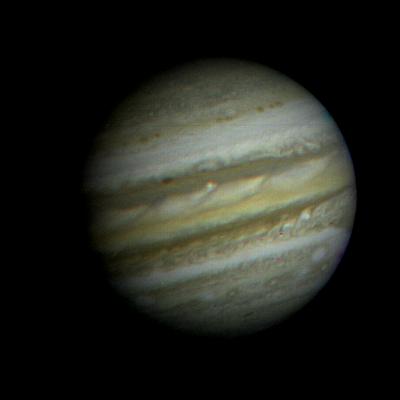
The filmstrip uses a curated sequence of official mission imagery: spacecraft hardware, planetary encounters, and the view back toward Earth.
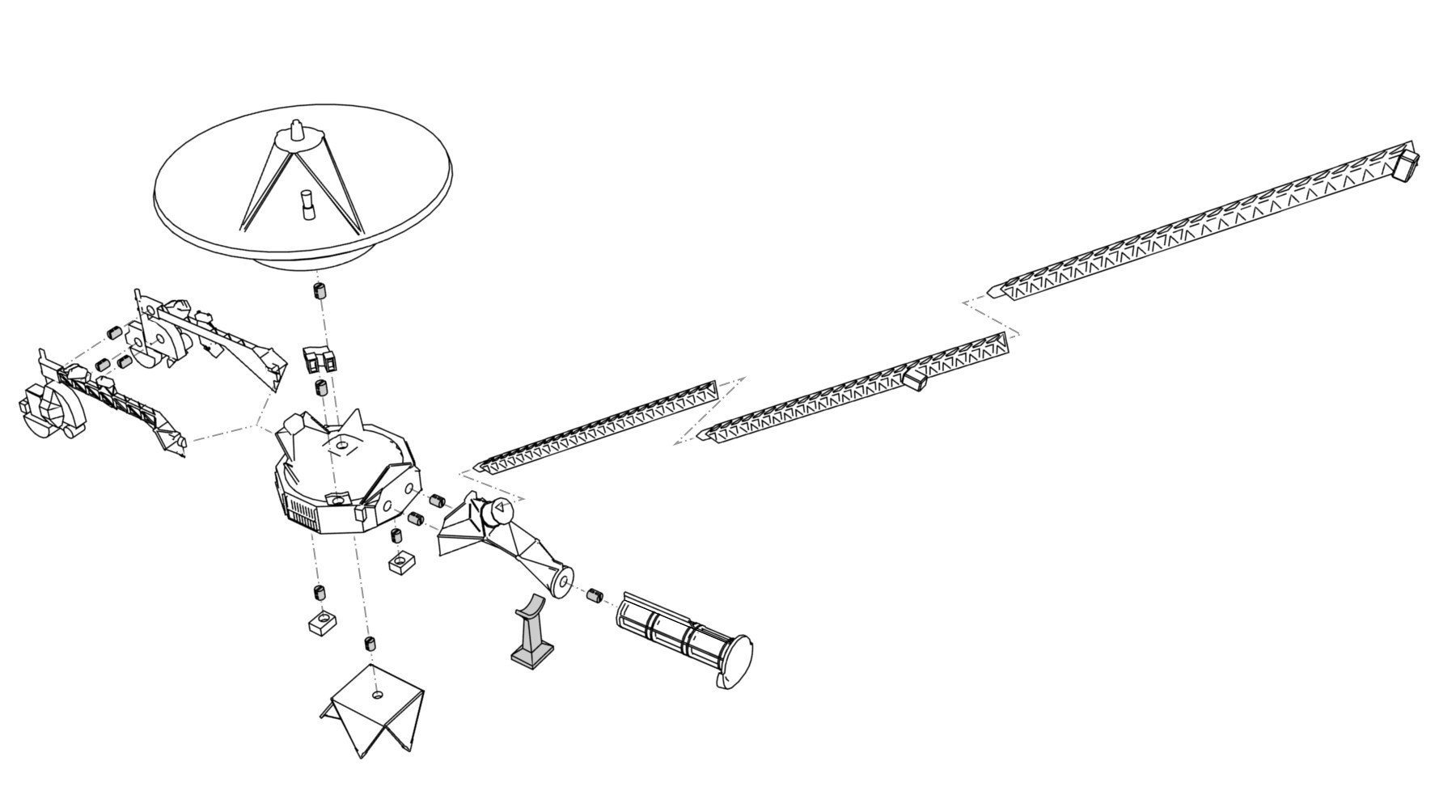
Voyager 1 spacecraft assembly and antenna hardware
Spacecraft assembly

Voyager 1 flight hardware and antenna geometry.

Courtesy NASA/JPL-Caltech
Voyager 1 view of Jupiter during the 1979 flyby
Jupiter encounter

Voyager 1's 1979 close-up view of Jupiter.

Courtesy NASA/JPL
Voyager 1 view of Saturn and ring structure
Saturn encounter

Saturn and ring structure before closest approach.

Courtesy NASA/JPL-Caltech
Pale Blue Dot: Earth seen by Voyager 1 from the outer solar system
Pale Blue Dot

The Earth seen from the outer solar system.

Courtesy NASA/JPL-Caltech
Voyager 1 family portrait of the solar system planets
Solar system portrait

The famous family portrait sequence from Voyager 1.

Courtesy NASA/JPL-Caltech

Mission Statistics / Ops Snapshot

Here the most important mission quantities stand side by side: mission age, time in interstellar space, distance, signal travel time, instrument status, and the tight power budget that defines the mission’s daily reality.

Mission Age
0
continuous since launch
historical · launch baseline
Interstellar Age
0
time since entry into interstellar space
historical · interstellar crossing
Distance AU
0
astronomical units
derived · browser estimate
Distance km
0
browser-side estimate
One-Way Light Time
0
command travel time
derived · browser estimate
Round-Trip Loop
0
send, wait, receive
derived · 2 × one-way light time
Outward Drift
~3.56 AU/y
approximate yearly increase
Velocity
~61,000 km/h
radial speed reference
official mission reference
Realtime Downlink
160 bit/s
low-rate engineering reality
official current mission reference
Max DSN Mode
1.4 kbit/s
large antenna support mode
official current mission reference
Active Instruments
LECP / MAG / PWS
three-instrument era
official current instrument state
LECP MAG PWS
Power Decline
~4 W/y
endurance through prioritization
official mission / jpl reporting
power constrained

Data Authority / Verification Layer

This section explains how the page handles truth. Some values are fixed historical baselines, some are official current mission references, and some are transparent browser-side estimates used to keep the page readable even without a live API connection.

Verified values
official / current / historical
Instrument status, launch date, interstellar crossing date, Golden Record counts, and the official mission framing belong to the verified layer.
verified historical baseline official media
Use this for: launch, interstellar age baseline, instrument state, Golden Record contents, and fixed mission milestones.
Estimated values
derived / browser-side
Distance estimate, one-way light time, and round-trip loop are currently computed locally from a transparent model so the interface stays alive while preserving honesty about precision.
estimated fallback-safe
Use this for: AU, km, one-way light time, and round-trip loop until a direct current-data backbone is wired in.
Source of truth
NASA Science / Voyager mission pages
mission framing, milestone facts, Golden Record structure, current mission context
official
NASA Science / “Where are Voyager 1 and 2 now?”
current status framing, instrument status, official note about live-position handling
official current
NASA Eyes / JPL Horizons
authoritative current-position path for future Step-9 integration
official position
NASA Image Library / NASA Science media
official visuals, credits, and media provenance
official media
Current page state
hybrid authority mode
This version combines verified official mission facts with transparent browser-side distance and light-time estimates.
Status: official historical baselines active · current numeric live mode still estimate-driven
Last refresh logic
page boot
The page updates locally every second for the visible counters, but its authority model stays explicit about what is historical, verified, or derived.
Refresh model: UI refresh ≠ official mission refresh
Reading rule
trust labels first
When reading any KPI, treat the badge as part of the value. The badge tells you whether the number is fixed, official-current, or estimated.
verified historical estimated
Why this matters
authority over decoration
The page aims to become the most informative Voyager 1 resource. That only works if visual impact never blurs the distinction between official facts and display-oriented estimates.
Methodology 01
fixed history
Launch, heliopause crossing, Pale Blue Dot, and other milestones are treated as historical anchors, not as values that need runtime uncertainty.
Methodology 02
transparent derivation
Current distance and signal timing stay explicitly marked as locally derived until a direct official data-backbone step is implemented.
Methodology 03
official-first media
Images, archival references, and cultural payload notes stay tied to official NASA/JPL source paths whenever possible.
Methodology note: A moving interface can feel more certain than it is. This section exists to counter that effect. The page remains intentionally explicit about which values are authoritative, which are historical, and which are runtime estimates meant to preserve readability until a direct official-current API layer is added.

Console Deck

The Console Deck summarizes the operational perspective: status indicators, telemetry, signal path, system state, and the bridge to the wallboard for desktop, TV, and kiosk views.

Signal Path / Command Link
EarthDSN uplinkVoyager 1blink + log output
LINK READY UPLINK WINDOW OPEN

What this deck brings together

This deck combines the signal path, terminal-style telemetry, wallboard behavior, kiosk presentation, and the key operational values that define Voyager 1 in its interstellar phase.

Telemetry stream
BOOTING CONTROL ROOM...
Round-Trip Loop
0
outbound and return waiting time
Distance AU
0
control-room distance class
Telemetry State
READABLE
engineering telemetry available
stable
Link Class
DEEP SPACE
high-latency mission link
delayed return
Distance Room · Exhibit Label

Deep Space Scale Experience

A calm scroll narrative from Earth through the solar system and heliosphere to the spacecraft. Not a toy effect, but a visual re-scaling of distance.

Story Flow 01
Emotion → Orientierung
The farther you scroll, the smaller Voyager appears. The stage grows quieter, darker, and emptier.
Story Flow 02
Solar system → heliosphere → interstellar
The labels shift step by step. The spacecraft remains visible, but never dominant.
Story Flow 03
No fake real-time data
The module illustrates scale and story, not exact live positions.
Stage: Earth Orbit
Scale cue: Inner Solar System
Voyager visual size: archive marker
SUN EARTH HELIOSPHERE / HELIOPAUSE CONTEXT VOYAGER 1

Mission Timeline / Threshold Moments

The mission reads best when the chronology is visible as a sequence of thresholds: launch, planetary encounters, cultural images, boundary crossings, and the current endurance era.

05 Sep 1977

Launch from Cape Canaveral

Voyager 1 began its mission on a Titan-IIIE-Centaur rocket and entered a trajectory shaped by the outer-planet alignment of the late 1970s.

start mass · 825.5 kglaunch complex 41
05 Mar 1979

Jupiter flyby

The Jupiter encounter transformed the mission into a major scientific event: atmosphere, rings, radiation environment, and the Galilean moons were observed in rapid sequence.

17,477 images115.2 kbit/s
12 Nov 1980

Saturn / Titan decision point

The Saturn encounter and the Titan flyby fixed Voyager 1’s future path and redirected it away from any continuation to Uranus or Neptune.

44.8 kbit/sfinal planetary flyby
01 Jan 1990

Interstellar mission era begins

By 1990, Voyager 1 had fully transitioned from planetary flyby probe to long-duration heliospheric and interstellar observatory.

mission life redefined
14 Feb 1990

Pale Blue Dot / family portrait

The imaging era closed with one of the mission’s most enduring cultural gestures: the family portrait and the tiny Earth in a sunbeam.

6 planets in portraitEarth from 6.4 bn km
Feb 1998

Most distant human-made object

Voyager 1 overtook Pioneer 10 in distance and has remained the most distant human-built object ever since.

distance leadership
16 Dec 2004

Termination shock crossing

The spacecraft entered the heliosheath environment, where the influence of the solar wind had already changed dramatically.

~94 AUmagnetic field shift
25 Aug 2012

Interstellar space

Voyager 1 became the first human-made object confirmed to have crossed into interstellar space.

first of its kindheliopause crossed
2023 → 2026

Recovery and endurance era

Unreadable telemetry, FDS recovery work, renewed engineering/science data, and difficult power-saving decisions define the late mission phase.

science recovered in 2024CRS off in 2025

Timeline Reading Notes

This side panel translates the chronology into narrative categories, so the page does not read as a loose list of dates but as a sequence of mission transformations.

Phase 01 · Planetary reconnaissance
From launch through Saturn, the mission was driven by flyby geometry, imaging, instrument activation, and the need to compress major science returns into narrow encounter windows.
Phase 02 · Cultural closure of imaging
The 1990 portrait sequence ended planetary imaging, but it also gave the mission its most famous image and a long-lasting public meaning beyond raw science data.
Phase 03 · Boundary science
Termination shock, heliosheath, heliopause, plasma density, and field measurements redefined Voyager 1 as a probe of the Sun’s outer frontier.
Phase 04 · Endurance operations
The contemporary mission is defined by watts, thermal limits, low-rate telemetry, memory workarounds, and the long rhythm imposed by extreme signal delay.

Discovery Metrics

These are the numbers that make Voyager 1 visually understandable: not only distance and delay, but concentrated moments of discovery, image return, and cultural scale that can be read at a glance.

Jupiter image return
17,477
images transmitted during the Jupiter-system investigation at the mission’s peak flyby tempo.
Active volcanoes on Io
9
Voyager 1 detected active volcanism on Io, one of the mission’s most dramatic discoveries.
New moons identified at Jupiter
2
Metis and Thebe were identified in the Jovian system during the extended survey.
Galilean moon sequence
30 h
Voyager 1 passed the four large Jovian moons in roughly thirty hours, compressing a major science campaign into a single burst.
Family portrait planets
6
The 1990 family portrait assembled six planets into one last outward-looking image set.
Pale Blue Dot distance
6.4 bn km
Earth appeared as a tiny point of light at a distance that permanently altered the mission’s public symbolism.
Golden Record image set
115
The cultural payload carried 115 encoded images, turning the spacecraft into both observatory and message vessel.
Spoken greetings
55
The Golden Record preserved greetings in fifty-five languages as a human signature attached to a scientific mission.

Current Data Backbone / Horizons Integration

This section turns the page’s current-position logic into a safer operating model. It keeps the page readable in fallback mode, but adds a practical bridge to official current-position workflows through NASA Eyes, JPL Horizons presets, and a manual official-data import path.

Mode state
fallback estimate
The page now tracks whether visible current-position values come from the local display model or from an imported official-current override. In this corrected version, the readouts below are fed from a shared current-data snapshot.
fallback estimate active source · local model
Current AU
--
Current km
--
One-way light time
--
Timestamp
--
Important: JPL’s SSD/CNEOS API service states that the APIs should not be embedded directly in public websites due to NASA CORS policy. This page therefore treats Horizons as an official current-data bridge, not as an automatic always-on browser fetch.
Official position bridge
NASA Eyes
NASA points readers to Eyes on the Solar System to see where Voyager 1 is at this moment. This page therefore links out to Eyes rather than pretending to replace it.
Official ephemeris bridge
JPL Horizons API
Horizons API is the official machine-readable ephemeris path. The page now generates a Voyager 1 preset and exposes it as a controlled bridge for future production integration.
Horizons API docs
Official-current override
manual import
Because direct browser embedding is not the right production path, this page can accept a manually pasted official-current value set and immediately switch visible KPIs to “official imported mode.”
import state · waiting
Why this design is honest
authority before illusion
The page stays dynamic, but it never blurs the difference between a locally derived estimate and a current value coming from an official source path.
Horizons preset builder
Voyager 1 preset
This generated URL is meant as a reproducible official-current preset for Voyager 1. The page displays it, lets you copy it, and treats it as the future backbone for a server-side or preprocessing workflow.
building preset…
Preset intent: Voyager 1 as target body, JSON output requested, current UTC time window, and a single-step ephemeris/vectors-oriented backbone for current-position work. The exact operational query can be refined later in the production pass as needed.
Manual official data import
paste / apply / fallback
Paste either a simple “AU / km / light-time / timestamp” block or a Horizons-oriented note. The parser will look first for AU, then derive km and light time if needed.
Operational rule: imported values win over the browser estimate until fallback is re-enabled. This lets the page behave like a trustworthy exhibit layer even when fully automatic browser-side live fetching is intentionally avoided.

Official Mission Status Deck

This section separates the official status layer from the more interpretive systems storytelling below. It summarizes the currently active Voyager 1 instrument set, recent power-management decisions, and the page’s current official-reading notes.

Voyager 1 / official-style instrument table
three active investigations
This table is the factual status layer. The Systems section below remains the explanatory / interpretive layer.
instrument
state
changed / since
why it matters
MAG · Magnetometer
active
current era
Still core to interstellar magnetic-field measurements.
PWS · Plasma Wave System
active
current era
Still central to plasma-wave / interstellar environment reading.
LECP · Low-Energy Charged Particles
active
through 2025 / off planned next
Part of the final active science set, but already under shutdown planning.
CRS · Cosmic Ray Subsystem
off to save power
25 Feb 2025
Powered down as part of the mission-extension power-conservation plan.
Operational reading rule: this is the factual status layer. The sections below explain meaning, trade-offs, and engineering consequences. Read this deck first when you want the cleanest current-state summary.
Current official state
interstellar / still operating
NASA’s current mission framing continues to treat Voyager 1 as an active interstellar spacecraft, with current position handled through NASA Eyes and current mission notes concentrated in the official status pages.
interstellar telemetry readable power constrained
Official note
Eyes for position
The page now openly follows the official split: use NASA Eyes for current position, use NASA/JPL mission updates for current status, and use Horizons as the machine-readable bridge for deeper ephemeris work.
Power plan note
~4 W/y
The current status cannot be separated from power decline. The 2025 shutdown decisions are part of a long strategy to keep at least one instrument operating into the 2030s.
Why this deck exists
fact first
The page is long and rich. This dedicated status deck gives readers one clean place to answer the simple question: what is officially still on, what is off, and what is the current mission posture?

Scientific Deep Dives

This section adds the missing science layer: not just milestones and metrics, but the physical meaning of Voyager 1’s interstellar measurements. It explains what changed at the edge of the heliosphere, why the 2012 crossing was scientifically difficult, and what the surviving instrument set still tells us.

Heliosphere / heliosheath / heliopause
Voyager 1 did not simply “leave the solar system” in one easy cinematic moment. The real story is a layered boundary region: solar wind slows at the termination shock, the heliosheath becomes a mixed transition zone, and the heliopause marks the shift where interstellar plasma conditions dominate. SUN TERMINATION SHOCK HELIOPAUSE VOYAGER 1 HELIOSHEATH
Magnetic field and plasma waves
The surviving science picture depends heavily on MAG and PWS. The magnetometer tracks the local magnetic field structure, while the plasma wave system helps reveal changes in plasma conditions. Together they helped turn the “interstellar crossing” from a symbolic headline into a measurable physical transition.
Cosmic rays and particle shift
One of the key signatures of the crossing era was the strong drop in anomalous cosmic rays and the rise in galactic cosmic rays. That particle shift was one of the big clues that Voyager 1 had entered a different environment, even before every interpretation issue had been resolved.
Why 2012 was scientifically hard to confirm
The headline was easy. The science was not. Researchers had to reconcile multiple indicators: particle populations, magnetic-field behavior, plasma-density evidence, and the absence of one perfectly theatrical boundary signal. That is why the crossing became one of the most interesting interpretation problems in the late mission.
What the active instruments still measure
Voyager 1’s remaining science is narrower, but not trivial. MAG, PWS, and LECP still support interstellar field, plasma-wave, and charged-particle readings. The reduced instrument set is part of the story: less breadth, but still a meaningful window into an environment no other human-built object reached first.
Boundary science

Crossing is a process, not a line

The science becomes clearer when the boundary is shown as a layered transition rather than a single dramatic edge.

Use this card as the interpretive bridge between Timeline and Systems.
Particle environment

Anomalous down / galactic up

Particle populations changed in a way that strongly suggested a new environment beyond the Sun’s dominant plasma envelope.

ANOMALOUS COSMIC RAYS GALACTIC COSMIC RAYS
Instrument meaning

Why three instruments still matter

The surviving instrument trio is enough to keep Voyager 1 scientifically relevant in the interstellar medium.

MAG · field PWS · plasma waves LECP · particles
This section prepares the reader for the Status and Systems layers by explaining why “still active” matters scientifically, not just operationally.

Definitive Official Media Archive

This section turns the page’s visual layer into a more authoritative archive. The goal is not only to show strong imagery, but to separate official mission photography, official artwork, and cultural payload references in a way that stays clean, searchable, and credit-aware.

Archive rule
official-first visuals
The archive groups Voyager 1 visuals by subject and type. It treats mission photography, spacecraft imagery, and Golden Record references as separate collections so the page stays readable even as it grows.
official mission image

Spacecraft assembly

Use for hardware identity, antenna geometry, and physical recognition of Voyager as an object, not only a mythic symbol.

NASA / JPL-Caltech
official mission image

Voyager in context

Use for hero transitions, technical cards, and media taxonomy entries where the spacecraft itself is the primary subject.

NASA / JPL-Caltech
official encounter image

Jupiter encounter set

Best used for discovery storytelling: Io volcanism, the Galilean moon sequence, and the first wow-factor planetary science layer.

NASA / JPL
official encounter image

Io and active volcanism

Use as the scientific drama card that visually explains why Voyager 1 changed planetary science so dramatically.

NASA / JPL
official encounter image

Saturn / ring structure

Best used for the transition from flyby spectacle to trajectory consequence: Saturn is both beauty and mission turning point.

NASA / JPL-Caltech
official atmosphere image

Titan atmosphere

Use to explain why Titan mattered so much and how that flyby helped define Voyager 1’s final long outbound path.

NASA / JPL-Caltech
official cultural image

Pale Blue Dot

This is not just a picture. It is one of the strongest cultural anchors in the mission and belongs in its own archive grouping.

NASA / JPL-Caltech
official image sequence

Family portrait

Use as the closing image layer of the planetary era and as the bridge from imaging mission to deep-space memory object.

NASA / JPL-Caltech
official cultural payload

Record cover / pulsar map

Use for the symbolic side of the mission: discoverability, encoding, and the spacecraft as a human message carrier.

NASA / JPL-Caltech
official content reference

115 images / 55 greetings

The Golden Record archive should stay clearly separated from freely embeddable media assumptions.

NASA / JPL-Caltech
official ground segment context

Deep Space Network context

Use for signal-delay chapters, wallboard logic, and all sections where the communication chain is part of the story.

NASA / JPL-Caltech
official diagram / concept layer

Status / trajectory support visuals

Separate clearly from mission photography. These belong to the explanatory layer, not the encounter-photo layer.

NASA / JPL-Caltech
Archive note: this section is intentionally metadata-oriented. It is built to become the clean catalog layer above the existing filmstrip and image surfaces, not a random media wall.
How this connects to the current page
filmstrip → archive
The current filmstrip remains the fast visual teaser. This new archive section becomes the structured catalog layer that tells readers what type of official visual they are looking at and why it matters.
role split

Filmstrip

Fast editorial teaser using a handful of highly recognizable official images.

role split

Media archive

Structured catalog by subject, mission phase, and meaning.

role split

Golden Record

Cultural payload archive kept distinct from mission photography and rights assumptions.

credit rule

Always official-first

Each media grouping is designed to carry source, type, and credit so the site becomes more authoritative as it grows.

Production direction for the next pass: the actual next build can attach real official image cards, captions, years, source URLs, and credit strings to these archive groups without changing the section logic.

Systems Layer

The spacecraft now has to be read as an instrument economy: a shrinking power budget, a narrowed science set, and a few remaining systems that still define the interstellar mission.

Mission type
Flyby → Interstellar
The spacecraft changed from a planetary encounter probe into a long-duration interstellar observatory.
High-gain antenna
3.7 m HGA
The large dish remains the physical center of communications discipline and attitude control.
Power source
3 RTGs
Voyager 1 is still powered by three radioisotope thermoelectric generators with steadily declining output.
Instrument era
LECP · MAG · PWS
The mission has entered a reduced but still scientifically meaningful three-instrument phase.
Instrument matrix / late-mission state

What is still alive, what was retired, and why it matters

The matrix turns instrument history into a readable operational surface. The goal is not to list everything equally, but to show the narrowing science set and the logic behind the remaining active chain.

MAG · Magnetometer
active
interstellar core
PWS · Plasma Wave System
active
interstellar core
LECP · Low-Energy Charged Particles
active
planned 2026 off
CRS · Cosmic Ray Subsystem
powered down
25 Feb 2025
UVS · Ultraviolet Spectrometer
retired
19 Apr 2016
ISS / IRIS / PRA / RSS
historic
planetary era
active science scheduled / constrained powered down
Active science chain

Three instruments carry the current mission

MAG measures the magnetic field, PWS tracks plasma-wave behavior, and LECP samples charged particles. Together they keep Voyager 1 scientifically meaningful despite the shrinking power margin.

Retired systems

The planetary payload became an archive

Cameras, infrared work, ultraviolet science, and other early-mission tools now belong mostly to the historical layer of the spacecraft. Their retirement defines the transition from imagery to field-and-particle science.

Telemetry logic

Pointing, power, and data remain tightly coupled

Any instrument state has to be read together with attitude control, thermal conditions, telemetry formatting, and the long wait cycle imposed by deep-space communications.

Mission constraint

Every active line costs watts

In the endurance phase, the spacecraft is no longer judged by maximum capability, but by how carefully limited capability can be preserved.

Mission Operations Deck

The Operations Deck now reads more clearly as an operations room: mission position, command delay, instrument state, return windows, and the late-era recovery context are presented as one connected operating reality instead of isolated widgets.

Mission ops strip
0

The mission state is retold as a single ops strip—with distance, one-way delay, return loop, and a calm abstract position between the heliopause and deeper interstellar space.

Sun
Heliopause
Voyager 1
telemetry readable power constrained three instruments active
Distance AU
0

Distance read as an operational quantity, not just a headline number.

One-way delay
0

The waiting time for a command to reach the spacecraft.

Return loop
0

Outbound and reply together as a mission-ops cycle.

Telemetry class
READABLE

The late-mission recovery era remains part of the operating frame.

Ops Dashboard

The dashboard below summarizes the current operating reality: the active science chain, the power economy, and the slow command/response rhythm imposed by deep-space communications.

Instrument / subsystem status
LECPON
MAGON
PWSON
CRSOFF / SAVE POWER
Mission-control ratios
1977 1990 2012 2026
distance abstractionavailable power pressurestable 3-instrument era
Ops terminal / command cadence
OPS CLOCK WAITING FOR UPDATE DSN ROUTE EARTH → DSN → VGR1 SIGNAL DELAY CALCULATING MISSION STATE EXTENDED INTERSTELLAR OPS POWER MODEL RTG DECAY ~4 W/Y INSTRUMENTS LECP / MAG / PWS ACTIVE WALLBOARD DESKTOP / TV / KIOSK READY ANIMATION RULE TWO PASSES, RESTART ON RE-ENTRY
01 · Review

Commands are checked against power, attitude, and telemetry consequences before anything is sent.

02 · Uplink

The command leaves Earth through the Deep Space Network and enters a long one-way transit.

03 · Wait cycle

The spacecraft acts first; understanding comes only after the delayed reply arrives back at Earth.

Late Mission Recovery

Why the operations layer now includes repair history

By the 2023–2026 era, operations and recovery can no longer be separated. Readable telemetry, rerouted software logic, and strategic instrument shutdowns are part of the same daily mission reality.

Late 2023Unreadable returns made the ops problem visible to the public, even while command capability remained.
April–June 2024Engineering data, then science data, became readable again through careful fault isolation and software workarounds.
2025–2026Power-saving decisions and the reduced active-instrument set became part of the continuing ops discipline.

Wallboard / Kiosk / Keyboard Control Surface

This surface makes the interaction logic clearly visible: direct mode switching, keyboard shortcuts, and a large, dense number view for desktop, TV, and exhibition use.

Keyboard shortcuts

W / K / D
Wall / Kiosk / Dense
Direct switching among the main display modes.
F / Space
Fullscreen / Pause
Fullscreen and rotation control for TV or museum use.
← / →
Slide control
Manual wallboard slide step.
Esc
Close
A clean exit from the monitor surface.
Maximal control room summary
0
Giant-type summary of mission age, distance and light-time for exhibit mode.
CONTROL SURFACE SYNC PENDING…

Signal Delay / Command Reality

The communications layer is now staged more explicitly as an operating process: command planning, one-way transit, delayed interpretation, and the slow return of telemetry from interstellar space.

Earth ↔ Voyager command path
Idle. Awaiting manual simulation.
Command state machine
STATE 00 READY STATE 01 LINK QUIET STATE 02 NO SIMULATION ACTIVE
link stable extreme delay
Interpretation

The visualization compresses a much longer real delay into a short UI sequence so the structure of the communication process becomes visible without pretending to show real mission timing.

Signal process ladder
Command sent

The uplink leaves Earth after the team has already modeled likely consequences.

Waiting…

The spacecraft receives and acts long before the team on Earth can see the result.

Telemetry received

Only after the reply returns can engineering meaning be attached to the change.

Command / return route
COMMAND OUTBOUND TELEMETRY RETURN EARTH / DSN VOYAGER 1

Power / Endurance Deepening

Voyager 1 is now best understood as an endurance mission shaped by electrical decline. The real story is not simply that power is low, but how the mission is continuously rebalanced around that fact.

RTG output
254.6 W
Loss since launch
~46%
Yearly decline
~4 W/y
Fuel reserve
17.38 kg
Power economy

Declining watts define the mission more than distance alone

Power loss drives instrument shutdowns, heater decisions, and the order in which engineering teams protect the spacecraft. That makes electrical decline the core management variable of the late mission.

budget under pressure science still active shutdowns extend life
1977 1998 2012 2030s mission threshold band available electrical power
Anomaly and endurance timeline

Recent years are a chain of recovery events

The endurance era is not passive decline. It is an active engineering sequence in which communication, memory workarounds, transmitter behavior, and instrument choices are repeatedly renegotiated.

May 2022

Telemetry confusion

Voyager 1 began returning contradictory engineering information even though the spacecraft itself still responded to commands.

late 2023

Unreadable data stream

The FDS/TMU path became the defining problem, turning the mission into a patient, long-distance debugging exercise.

Apr–Jun 2024

Engineering then science recovery

Readable engineering data returned first, followed by science data from the remaining active instruments.

Oct–Nov 2024

Transmitter interruption

An automatic protection response pushed communications into a weaker mode until regular operations could be restored.

Feb 2025

CRS switched off

The Cosmic Ray Subsystem was turned off to preserve the broader life horizon of the spacecraft.

2026 onward

Narrowed science horizon

The spacecraft continues in a tighter operating envelope in which every watt saved can buy more mission time.

Remaining contact horizon
2030s

Public mission framing often places the last realistic communications horizon in the 2030s, assuming no major surprise interrupts the spacecraft earlier.

Hydrazine margin
to ~2040

Fuel is not the only issue, but it remains a critical long-tail factor in keeping the antenna properly pointed back toward Earth.

Operational lesson
preserve watts

The endurance phase shows how long-lived spacecraft survive: not by keeping everything alive, but by knowing what can be sacrificed in time.

Engineering Gallery · Exhibit Label

Engineering Recovery Story

This layer now treats the late-mission computer problem as a recovery narrative: fault detection, memory suspicion, rerouting, returned engineering updates, and the slow reassembly of scientific readability across extreme signal delays.

FDS memory problem / public narrative

The core public story of the 2023–2024 crisis was not dramatic single-command heroism but disciplined fault isolation. Engineers needed to understand which memory areas could no longer be trusted, how to relocate logic, and how to restore readable packets without breaking other functions.

suspect memory range rerouted storage / logic
Readable telemetry as milestone
Problem visibilityLate 2023 made the issue legible from Earth: the spacecraft still responded to commands, but useful telemetry was no longer arriving in an interpretable way.
Engineering updates restoredIn April 2024, the first major recovery milestone was not full science normality but readable engineering state.
Science chain restoredThe recovery of science data in stages turned the mission back into a working observatory rather than a silent object under command only.
01 · Detect

Contradiction first

The spacecraft still heard commands, but the team on Earth no longer received meaningfully interpretable results.

02 · Isolate

Suspect memory regions

The likely problem had to be narrowed to code and data areas that could no longer be trusted for clean packet generation.

03 · Reroute

Move logic around damage

The response was not replacement hardware but careful software and storage reorganization around the failing region.

04 · Verify

Engineering first, science next

The team accepted progress in layers: readable engineering state first, then science return, then ongoing operational stability.

Signal decoding visualization
analog carrier impression decoded framed bits (stylized)
Simplified error-correction view
FRAME A 10110101 parity OK FRAME B 10111101 parity mismatch FRAME C 10110101 majority vote RESULT 10110101 frame accepted This visualization is intentionally stylized. It shows only the principle of checking, comparison, and conservative acceptance.
Recovery principle
GOAL restore readability, not spectacle METHOD cautious tests across long delays PRIORITY engineering state first THEN science packet recovery RULE preserve mission life while recovering meaning
Cultural Payload Room · Exhibit Label

Golden Record Interactive View

The Golden Record is now organized as an interactive catalog divided into Greetings, Sounds und Images —with clear indication of usage-rights boundaries.

Greetings Atlas

Fifty-five spoken greetings make up the documented Earth-message section. Here they appear as a curated category, not as a loose footnote.

Intent

This module shows the human side of the mission: not measurements, but greeting, voice, and civilization.

Use on this page

Text and structural references are fine. No media with unclear rights is embedded here.

Credit

Golden Record context presented as historical mission reference.

Courtesy NASA/JPL-Caltech

Sounds

Natural and everyday sounds are part of the Earth signature carried on board.

Rights notice

Music should not be treated as freely reusable here. That is why this module deliberately stays limited to references and catalog logic.

NASA-only audio guide

Only prepared placeholders for NASA Historical Sounds, NASA Sounds from Beyond, and NASA Data Sonifications.

Website policy

No third-party music, no uncertain audio embeds, only conservative official references.

Images Atlas

Images of Earth, life, science, and everyday human activity.

Cover Atlas

The cover with its pulsar map and playback instructions is one of the strongest objects in the mission’s symbolic vocabulary.

Interpretation

This module ties culture and engineering together: medium, encoding, representation, and the wish to be discoverable.

Display mode

Ausstellungslogik statt unkontrollierter Medienwall.

Optional Audio Guide (NASA only)

The audio guide points only to official NASA audio sources. This page deliberately does not embed Golden Record music tracks, whose rights can be more complex outside the NASA source framework. The local interface only enables a quieter listening mode.

Status: OFF
Source: NASA-only references
Embedded music: disabled by design

NASA Historical Sounds

For an optional listening experience with a more conservative rights profile. Intended as an external jump point rather than an embedded continuous loop.

NASA Sounds from Beyond

Well suited to a modern museum layer: space-related audio experiences and mission sounds from official NASA contexts.

Golden Record Guardrail

The Golden Record remains visible as a historical object, but music rights are intentionally not simplified here. That is why the module uses reference rather than uncritical embedding.

Audio Guide changes only the atmosphere of the interface: a stronger CRT layer, reduced distraction, listening cues in the story dock, and clear NASA-only linking. No autoplay audio, no third-party music, no uncertain rights assumptions.

Sources and data foundation

The page now treats current-position work as a two-layer system: official-current bridges through NASA Eyes and JPL Horizons, plus a transparent fallback estimate that keeps the interface readable when no imported current data is present.

JPL Horizons API
official source
JPL Horizons remains the official reproducible ephemeris path. In this Step-9 version, the page exposes a Voyager 1 preset URL and a manual official-data import model instead of pretending that direct browser embedding is the correct production solution.
NASA Images API
official source
The NASA Images API can deliver official image metadata, titles, descriptions, and credit lines. That would make it possible to pull titles, descriptions, and credits directly from official NASA metadata without relying on uncertain third-party archives.
Redaktionelle Regel
redaktionelle regel
This page clearly separates official sources from transparently extrapolated browser estimates. The editorial rule remains simple: every dynamic number needs a source, a timestamp, and a clear fallback note so readers immediately understand whether they are seeing an original value or an extrapolated estimate.

100 Facts Observatory — Visual Upgrade

The facts remain complete, but now appear as categorized cards instead of one long list.

Future Trajectory

Once the page has taught the mission as engineering and operations, the next step is to widen the horizon again. Voyager 1 will eventually fall silent, but the trajectory continues far beyond the final command window.

2030sProjected last contact window under current public mission framing.
2040+Hydrazine remains part of the long-tail survivability story.
40,000 yearsApproximate era of the Gliese 445 passage.
1.6 light-yearsEstimated closest approach distance, not a mission target but a geometric future encounter.
Contact horizon
2030s
Late mission communications are finite. The remaining years matter because every restored watt or deferred shutdown can move the last useful contact window.
Fuel horizon
~2040
Hydrazine is not the only boundary, but it remains essential for attitude control and keeping the high-gain antenna aligned with Earth.
Deep future
40,000 y
The spacecraft will continue long after the operations era has ended. At that point, the mission survives only as trajectory and artifact.
Future passage
Gliese 445
Voyager 1’s projected passage near Gliese 445 is one of the page’s strongest “deep time” anchors because it detaches the story from all human program cycles.

Voyager by the Numbers

This compression layer gathers the most useful anchor values into one clear grid. After the long scroll, it works as a pause point where the mission becomes legible again at a glance.

Mass
825.5 kg
A comparatively modest spacecraft carrying one of the longest-running stories in spaceflight.
Antenna
3.6 m
The dish remains the visual and operational center of the mission.
Power
254.6 W
Late mission life is a watt-management problem before it is anything else.
Realtime downlink
160 bit/s
The mission demonstrates that data value is not the same thing as data speed.
Velocity
~61,000 km/h
Fast relative to Earth, yet slow enough for interstellar distance to remain almost impossible to intuit.
Distance
~25.4 bn km
The kilometer number is so large that the page keeps translating it back into signal time and AU.
Golden Record
115 / 55
115 images and 55 greetings make the cultural payload legible in one line.
Ops loop
~44 h
A full command and return cycle is the human-scale number that makes the mission feel remote.

Closing Frame

The ending should not feel like the page simply stopped. It should feel like the mission moved beyond the readable window.

Why this ending is quiet

After systems, power, delay, repair, and cultural payload, the page narrows down to a simpler thought: the spacecraft will outlast its own communications era. That is the right emotional register for the final section.

contact will end trajectory continues artifact survives

End of signal.
Not end of journey.

Long after the final telemetry packet, Voyager 1 will still be moving. When operations are gone, the spacecraft remains: one line, one machine, one continuation through darkness.

a spacecraft still speaking across a light-day
Voyager 1 — Mission Wallboard
Desktop / TV / Kiosk / Mission Monitoring
Slide 1 · Mission Clock
0
Mission age, distance estimate and one-way light-time for big-screen display.
Distance
0
One-Way Light Time
0
Interstellar Age
0
Refresh
00:00:00
Slide 2 · Signal
Command sent

Waiting... Telemetry received. The kiosk compresses a long real-world loop into an operational story.

Slide 3 · Systems
LECP / MAG / PWS

Three-instrument era. Dense mode keeps the most meaningful status tiles visible at once.

Power

~4 W/y

Endurance through deliberate prioritization.

Culture

Golden Record

Greetings, sounds and images as a symbolic payload.

Wallboard state: Normal
Rotation: Running
Slide: 1 / 3